Janitorial, grounds maintenance, guard, equipment repair and many other federal service contracts carry minimum wages set by the Department of Labor. This page explains which contracts are covered, where the wage determination sits, how fringe benefits and new job classes work, what the clause asks after award, and how these rules differ from Davis-Bacon on construction.
Not legal advice: this article explains the general rules; the solicitation of each contract governs.
Key terms
- Service Contract Act (SCA)
- The McNamara-O'Hara Service Contract Act, now codified at 41 U.S.C. 6701 and following. The FAR calls it the Service Contract Labor Standards statute.
- Wage determination
- A Department of Labor document listing, for a locality, the minimum wage and fringe benefits for each class of service employee. It is attached to the solicitation and becomes part of the contract.
- Conformance
- The procedure in FAR 52.222-41(c) for adding a job class the wage determination does not list, with a wage set in relation to the listed classes, reported on Standard Form 1444.
- Successor contract
- A contract for substantially the same services in the same locality as an earlier one. If the earlier contractor's workers were under a collective bargaining agreement, its wages and benefits become the floor.
Which contracts are covered
The rules come from 41 U.S.C. chapter 67. Section 6702(a) applies them to any contract or bid specification made by the Federal Government or the District of Columbia that involves an amount exceeding $2,500 and whose principal purpose is to furnish services in the United States through the use of service employees. Negotiated or advertised, the procedure does not matter.
FAR 22.1003-1 adds that the type or name of the contract does not decide coverage. What counts is the principal purpose of the work. FAR 22.1003-5 gives examples: janitorial and custodial work, guard services, grounds maintenance and landscaping, snow and trash removal, food service, laundry, motor pool operation, maintenance and repair of equipment of all kinds, and data collection and processing.
Section 6702(b) lists exemptions. The first is the one a construction firm must know: contracts for the construction, alteration or repair, including painting and decorating, of public buildings or public works. Others cover carriage under published tariffs, communication and public utility services, and individual employment contracts.
Below the threshold, the Department of Labor's service contracts page states that contractors on contracts at or below $2,500 must pay the federal minimum wage under section 6(a)(1) of the Fair Labor Standards Act.
What the contract must state
Section 6703 lists the terms every covered contract carries. For each class of service employee, the contract states a minimum wage set in accordance with prevailing rates in the locality, or the rates in a collective bargaining agreement when one applies, and never below the federal minimum wage. It states the fringe benefits for each class on the same basis, such as medical or hospital care and pensions.
The contract also states that no services may be performed under unsanitary, hazardous or dangerous conditions, and that each employee receives notice of the required pay on the first day of work, either on a form or by a notice posted at the worksite.
FAR 22.1002-1 restates this and adds a limit on length: under 41 U.S.C. 6707(d), service contracts subject to the statute may not exceed 5 years.
Finding the wage determination
Under FAR 22.1002-2, contractors on service contracts over $2,500 pay at least the wages and fringe benefits the Department of Labor found prevailing in the locality. Without a wage determination, the Fair Labor Standards Act minimum wage applies.
The contracting officer gets the determination before issuing the solicitation. FAR 22.1008-1 says most prevailing wage determinations come from the Wage Determinations area of SAM.gov, and that when the right one is not there, the contracting officer requests it from the Department of Labor through the e98 process. SAM.gov describes a wage determination as the wages, fringe benefits and work rules found prevailing for a labor category in a locality, and it lets anyone search Davis-Bacon and SCA determinations by number.
Read the attached determination as a price list. Note its number, revision and date, the area it covers, and the hourly wage of every class your staff will work in. Then check the solicitation's amendments for a new revision before you submit.
There is one trap for firms taking over existing work. Under FAR 22.1002-3, a successor contract for substantially the same services in the same locality must pay at least the wages and fringe benefits of the predecessor's collective bargaining agreement, including prospective increases, even if no wage determination is incorporated.
Clause 52.222-41 after award
FAR 22.1006 tells the contracting officer to insert 52.222-41 in covered solicitations and contracts over $2,500, and in indefinite-amount contracts unless it is known in advance that the amount will be $2,500 or less. The clause in the FAR on 28 October 2026 is dated August 2018.
Paragraph (c) requires paying at least the wages in the attached wage determination. If an employee works in a class the determination does not list, the class must be conformed: you submit Standard Form 1444 to the contracting officer no later than 30 days after that class starts work on the contract. Spot unlisted roles while you price, not after award.
Paragraph (d) allows meeting fringe obligations with equivalent bona fide benefits or with equivalent or differential cash payments, under 29 CFR part 4, subpart D. Paragraph (g) requires telling each employee the minimum wage and fringe benefits, or posting the wage determination, and displaying the WH 1313 poster at the work site. Paragraph (i) requires keeping payroll and classification records for 3 years after completion, and paragraph (l) requires putting the clause in every covered subcontract.
Service Contract Act or Davis-Bacon?
A maintenance contract can include real construction work. FAR 22.402(b) says Davis-Bacon applies to construction in a nonconstruction contract when the work is on a public building or public work, the contract asks for a substantial amount of it above the Davis-Bacon threshold, and it can be performed separately from the other work. Simple installation incidental to supplies or services does not trigger it. The section gives the installation of heavy generators as an example of work that does.
In practice, a facilities contract may carry both wage determinations: SCA rates for the janitors and maintenance staff, Davis-Bacon rates for a roof replacement priced as a separate line. Price each part with its own rates and its own paperwork.
| Point | Service Contract Act | Davis-Bacon |
|---|---|---|
| Statute | 41 U.S.C. chapter 67 | 40 U.S.C. 3141 to 3148 |
| Work covered | Services performed through service employees | Construction, alteration or repair, including painting and decorating, of public buildings or works |
| Threshold | Contracts over $2,500 | Contracts over $2,000 |
| Workers covered | Service employees | Laborers and mechanics on the site of the work |
| Main clause | FAR 52.222-41 | FAR 52.222-6 |
| Payroll paperwork | Records kept 3 years after completion (52.222-41(i)) | Copy of all payrolls sent each week with a Statement of Compliance, records kept 3 years (52.222-8) |
| Pay frequency in the statute | Not set in section 6703 | At least once a week (40 U.S.C. 3142(c)) |
| Overtime above 40 hours | Contract Work Hours and Safety Standards Act on prime contracts over $100,000, per DOL | Same rule, per DOL |
What to put in your price
The wage determination is a floor for every hour of every covered employee. Your price carries that floor plus your own costs. The Department of Labor's page notes that on prime contracts over $100,000, the Contract Work Hours and Safety Standards Act requires time and a half for hours over 40 in a workweek, including for guards and watchmen.
If you take over a contract from another firm, ask the contracting officer whether a predecessor collective bargaining agreement applies, since its rates bind you under FAR 22.1002-3. On a multi-year contract, read the price adjustment clause of your solicitation to see how a later wage change is handled.
- Hourly wage per class from the attached wage determination.
- Fringe benefits per class, paid in benefits or in cash equivalents.
- Payroll taxes and insurance on top, as on any job.
- Overtime where the $100,000 prime contract rule applies.
- Office time for notices, conformance requests and records.
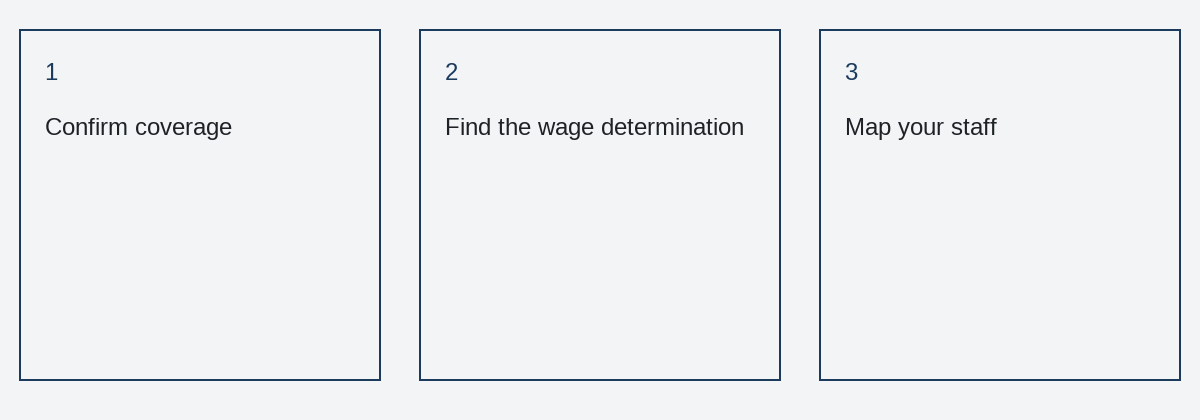
Reading the SCA rules in a service solicitation
- Confirm coverage. Check that the contract's principal purpose is services and that its amount exceeds $2,500.
- Find the wage determination. Locate the attached wage determination and note its number, revision and area.
- Map your staff. Match every employee role to a class listed in the determination, and list any role that needs conformance.
- Check for a predecessor agreement. Ask whether a predecessor collective bargaining agreement sets higher wages for this work.
- Look for construction work. Identify any substantial, separable construction work that would carry Davis-Bacon rates instead.
- Price the floor. Build each labor line from the wage, the fringe benefits and your own costs on top.
Frequently asked questions
Does the Service Contract Act apply to small contracts?
The wage determination rules apply to covered contracts over $2,500 under 41 U.S.C. 6702. The Department of Labor says contracts at or below $2,500 require the federal minimum wage under the Fair Labor Standards Act.
Can I pay SCA fringe benefits in cash?
Yes, 52.222-41(d) allows equivalent or differential cash payments in place of benefits, under 29 CFR part 4, subpart D. Your records should show how each amount was paid.
Where do I find the SCA wage determination?
It is attached to the solicitation. SAM.gov also lets anyone search Service Contract Act and Davis-Bacon determinations by number, but price from the one in your solicitation and its amendments.
What if my employee's job is not listed in the wage determination?
The class must be conformed under 52.222-41(c). You submit Standard Form 1444 to the contracting officer no later than 30 days after the class starts contract work.
Can a single contract carry both SCA and Davis-Bacon rates?
Yes. Under FAR 22.402(b), substantial and separable construction work in a service contract carries Davis-Bacon rates, while the service work keeps the SCA wage determination.
Sources and republications
The dates below concern links. They do not certify a full substantive review; claims and applicable versions still need review. Article review record.
- 41 U.S.C. 6702, Contracts to which this chapter applies (Cornell republication), link checked on
- 41 U.S.C. 6703, Required contract terms (Cornell republication), link checked on
- FAR 22.1002-1, General (Service Contract Labor Standards), link checked on
- FAR 22.1002-2, Wage determinations based on prevailing rates, link checked on
- FAR 22.1002-3, Wage determinations based on collective bargaining agreements, link checked on
- FAR 22.1003-1, Service Contract Labor Standards applicability, link checked on
- FAR 22.1003-5, Some examples of contracts covered, link checked on
- FAR 22.1006, Solicitation provisions and contract clauses, link checked on
- FAR 22.1008-1, Obtaining wage determinations, link checked on
- FAR 52.222-41, Service Contract Labor Standards, link checked on
- FAR 22.402, Applicability (Construction Wage Rate Requirements), link checked on
- 40 U.S.C. 3142, Rate of wages for laborers and mechanics (Cornell republication), link checked on
- FAR 52.222-8, Payrolls and Basic Records, link checked on
- U.S. Department of Labor, Wage and Hour Division, Government contracts: service contracts, link checked on
- SAM.gov, Wage determinations, link checked on