Many federal buys never appear as an open solicitation: they go to firms that already hold a GSA schedule contract. This page explains what the Multiple Award Schedule is, how agencies order from it under FAR subpart 8.4, when orders can be set aside for small business, and the steps GSA lists to get your own contract.
Not legal advice: this article explains the general rules; the solicitation of each contract governs.
Key terms
- Multiple Award Schedule (MAS)
- GSA's program of indefinite delivery contracts for commercial supplies and services at stated prices, also called the Federal Supply Schedule or GSA Schedules.
- Special Item Number (SIN)
- The category under which a schedule contractor offers a given product or service. Your pricelist sets out prices and terms SIN by SIN.
- eBuy
- GSA's electronic request for quotation system, where ordering activities post requirements and schedule contractors send their quotes.
- Ordering activity
- The agency office that places an order or sets up a blanket purchase agreement against a schedule contract.
What the Multiple Award Schedule is
FAR 8.402(a) describes the Federal Supply Schedule program, also called the GSA Schedules Program or the Multiple Award Schedule Program. GSA runs it. It gives agencies a simplified way to buy commercial supplies and services at prices tied to volume buying. GSA awards indefinite delivery contracts to many firms, each with stated prices, and agencies then order from those contracts.
Two levels exist. First, GSA awards you a schedule contract after evaluating your offer. That contract alone brings no work. Second, an agency places an order, or sets up a blanket purchase agreement, against your contract. The order is where the money is.
Each schedule contractor publishes an Authorized Federal Supply Schedule Pricelist under FAR 8.402(b). It lists the supplies and services you offer, with prices and terms for each Special Item Number. GSA also runs GSA Advantage!, an online shopping service where buyers search items and place orders, under FAR 8.402(c).
What you can sell through it
The schedule is not limited to construction, and not limited to supplies. GSA's MAS page groups its offerings into large categories, and buyers include federal, state, local and tribal governments and other authorized buyers, at pre-negotiated prices.
For a small contractor in the building trades, the facilities and industrial products categories are the usual entry points. Repair, maintenance and installation services can be ordered without a statement of work under FAR 8.405-1, when they are priced at a fixed price for a specific task. Larger construction projects are usually bought through their own solicitations, under the rules described in our pages on sealed bidding and negotiated proposals.
- Facilities; furniture and furnishings; human capital.
- Industrial products and services; information technology; miscellaneous.
- Office management; professional services; scientific management and solutions.
- Security and protection; transportation and logistics services; travel.
How agencies order from schedules
Ordering follows its own rules. FAR 8.404(a) says that Parts 13, 14, 15 and 19 generally do not apply to orders and blanket purchase agreements under schedule contracts, with a few exceptions. The ordering activity also may not seek competition outside the schedules or synopsize the requirement. So a schedule order may never show up as a public notice on SAM.gov.
GSA has already found the prices of supplies and fixed-price services fair and reasonable, under FAR 8.404(d). The agency may still ask you for an extra discount before it places an order. Expect that question, and decide in advance how far you can go.
The procedure then depends on the size of the order and on whether a statement of work is needed. The micro-purchase threshold and the simplified acquisition threshold are named in FAR 8.405-1 and 8.405-2 without their dollar values, so read the current figures in the FAR on the day you quote.
| Order size | Supplies, or services without a statement of work | Services priced at hourly rates, with a statement of work |
|---|---|---|
| At or below the micro-purchase threshold | Any schedule contractor that can meet the need; the agency should try to spread orders. | Any schedule contractor that can meet the need; the agency should try to spread orders. |
| Above micro-purchase, up to the simplified acquisition threshold | Best value after surveying at least three schedule contractors, for example through GSA Advantage!, or asking them for quotes. | Statement of work and request for quotes, with evaluation criteria, sent to at least three schedule contractors. |
| Above the simplified acquisition threshold | Competitive order: request for quotes posted on eBuy, or sent to as many contractors as practicable. | Competitive order: request for quotes posted on eBuy, or sent to as many contractors as practicable. |
| Fewer than three quotes received | The contracting officer writes a determination on the efforts made. | The contracting officer writes a determination on the efforts made. |
How a quote is chosen
Price is not the only factor. FAR 8.405-1(f) lets the ordering activity weigh past performance, special features, trade-in considerations, probable life of the item, warranty, maintenance availability, environmental and energy efficiency, and delivery terms. The request for quotes states the basis for selection, and every quote must be fairly considered.
For services with a statement of work, FAR 8.405-2 asks the agency to evaluate quotes against the criteria stated in the request, to look at the level of effort and the labor mix, and to confirm that the total price is reasonable. Your hourly rates are already on schedule; what gets judged is how many hours of which labor categories you propose.
If you lose an order decided on more than price alone, ask for the reason. FAR 8.405-2(d) says the agency shall give a brief explanation of the basis for the award decision when an unsuccessful offeror requests it.
Small business set-asides of orders
Because Part 19 does not generally govern schedule orders, the usual set-aside rules do not apply on their own. FAR 8.405-5(a)(1) gives ordering activity contracting officers a choice instead: at their discretion, they may set aside orders and blanket purchase agreements for any of the small business concerns identified in FAR 19.000(a)(3).
A set-aside order still follows the schedule ordering procedures of 8.405-1 through 8.405-3, and the requirements of Part 19 for each small business program apply. FAR 8.405-5(c) adds that ordering activities may consider socioeconomic status when they pick contractors, and should at least consider small business schedule contractors.
Size counts at the contract level in most cases. Under FAR 8.405-5(b), ordering activities should generally rely on the size representation made for the schedule contract, while the agency takes small business credit only if you meet the size standard of the order's NAICS code. Keep that representation accurate in SAM.
Getting your own schedule contract
GSA's roadmap lists the steps before you submit an offer on the MAS solicitation, which is posted on SAM.gov. Two of them are mandatory training steps. The Pathways to Success training takes three to four hours, according to GSA, and a readiness assessment must be completed by a designated Authorized Negotiator who is an employee of the company. Both are acknowledged in eOffer.
GSA looks at corporate experience and financial responsibility. The roadmap refers to two years of corporate experience providing the products or services in the solicitation; firms with less may still qualify through the Startup Springboard path if they meet its criteria, and other documents can show financial responsibility when two years of statements are missing.
Plan for a process, not a form. Read the entire solicitation and the category attachments before you start: they are the formal request for offers and set the evaluation criteria and the terms.
Is a schedule worth it for a small firm?
A schedule contract gives you the right to receive orders. Until an agency actually orders, it brings only obligations: keeping your pricelist current, reporting sales as your contract requires, and answering eBuy requests on time. Weigh those against how often agencies in your area buy what you sell through schedules.
A fictitious example: a small mechanical firm already doing open-market service calls for one federal campus learns that the facility office buys most maintenance through eBuy. Without a schedule contract, it never sees those requests. For that firm, the months spent on an offer may pay back. A roofer bidding mostly on large repair projects posted on SAM.gov would gain less.
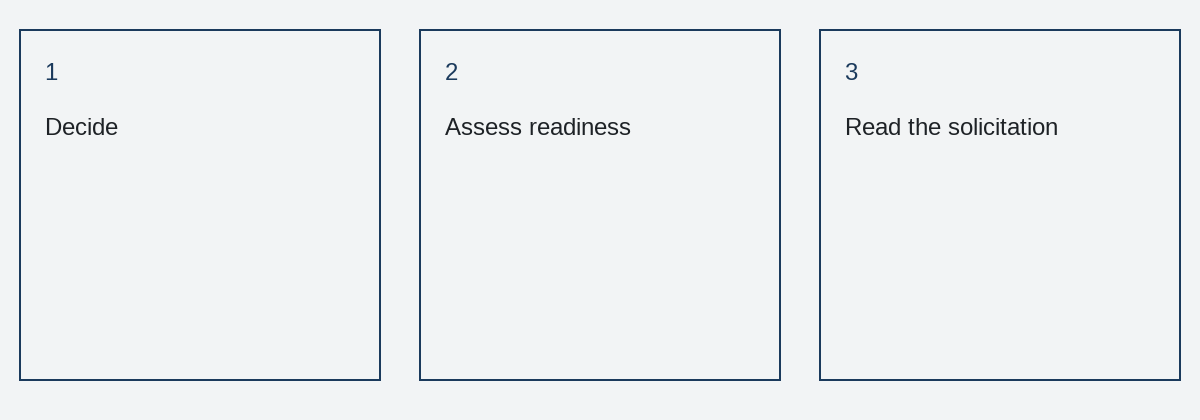
Preparing a MAS offer, step by step
- Decide. Check that agencies buy your products or services through schedules, and complete the Pathways to Success training.
- Assess readiness. Have an employee designated as Authorized Negotiator complete GSA's readiness assessment.
- Read the solicitation. Read the whole MAS solicitation on SAM.gov and the attachments for your category and SINs.
- Use the checklist. Go through GSA's new offeror checklist, which sums up the minimum content of your submission.
- Register. Complete the registrations GSA lists, starting with an active SAM registration.
- Gather the offer. Fill GSA's templates, prepare the eOffer fields and check the SIN-specific requirements.
- Submit. Log into eOffer with your FAS ID, upload the documents, sign and submit.
Frequently asked questions
Do I need a GSA schedule to win federal contracts?
No. Many contracts are bought through open solicitations on SAM.gov under FAR Parts 13, 14 and 15. A schedule contract matters when agencies buy what you sell through schedule orders, which FAR 8.404(a) keeps inside the schedules.
Will schedule orders appear on SAM.gov?
Often not. FAR 8.404(a) says ordering activities do not synopsize schedule requirements, and requests for quotes go through eBuy or directly to schedule contractors.
Can an agency set aside a schedule order for small business?
Yes, at the contracting officer's discretion under FAR 8.405-5(a)(1). The order still follows the schedule ordering procedures, and the Part 19 requirements for each program apply.
How long does it take to get on schedule?
The pages we checked give no fixed duration, so plan for a process rather than a form. The training, the readiness assessment and reading the full solicitation come before the offer itself.
Sources and republications
The dates below concern links. They do not certify a full substantive review; claims and applicable versions still need review. Article review record.
- FAR 8.402, General (Federal Supply Schedules), link checked on
- FAR 8.404, Use of Federal Supply Schedules, link checked on
- FAR 8.405-1, Ordering procedures for supplies, and services not requiring a statement of work, link checked on
- FAR 8.405-2, Ordering procedures for services requiring a statement of work, link checked on
- FAR 8.405-5, Small business, link checked on
- GSA, Multiple Award Schedule, link checked on
- GSA, Roadmap to get a MAS contract, link checked on