A notice marked as a small business set-aside tells you who the Government will accept offers from. This page walks through the rule behind set-asides, the size standard tied to the NAICS code, the SAM registration that must be active when you submit, and the representations you make with your offer. Each rule is linked to the official text.
Not legal advice: this article explains the general rules; the solicitation of each contract governs.
Key terms
- Set-aside
- A decision by the contracting officer to reserve an acquisition for small business concerns, announced on the notice and in a clause such as FAR 52.219-6.
- Size standard
- The ceiling, in annual receipts or number of employees, under which a firm counts as small for a given NAICS code, set by SBA in 13 CFR 121.201.
- SAM registration
- Your firm's record in the System for Award Management, with its Unique Entity Identifier and annual representations, which must be active to receive a federal award.
What the words 'set-aside' on the notice tell you
When a construction notice on SAM.gov says 'Total Small Business Set-Aside', the contracting officer has reserved the work for small business concerns. The solicitation then carries the provision at FAR 52.219-6, Notice of Total Small Business Set-Aside, and that clause sets the rule for who may submit an offer.
Paragraph (c) of FAR 52.219-6 states that offers received from concerns that are not small business concerns will be considered nonresponsive and rejected, and that any award will go to a small business concern. In other words, the question 'am I small for this job?' comes before any question of price or schedule.
Being small is measured against the size standard of the NAICS code the contracting officer picked for this solicitation, not against a general label. The same firm can be small under one code and large under another. The rest of this page explains how to check that, and what else must be in place before you submit.
Why the job was set aside: the rule of two
FAR 19.502-2 tells the contracting officer when a set-aside is required. For an acquisition above the micro-purchase threshold that does not exceed the simplified acquisition threshold, paragraph (a) says it shall be set aside for small business unless the contracting officer finds no reasonable expectation of offers of competitive offers from two or more responsible small business concerns.
For larger acquisitions, paragraph (b) says the contracting officer shall set the acquisition aside when there is a reasonable expectation that offers will come from at least two responsible small business concerns and that award will be made at fair market prices. People in the trade call this test the 'rule of two'; the FAR text itself does not use that name.
The thresholds are named in FAR 19.502-2 but their dollar values are not written in that section. Do not rely on a figure you saw on a blog or an old notice: read the definition in the current FAR on the day you need it.
One practical consequence: if no acceptable offer comes in on a set-aside under paragraph (a), the set-aside is withdrawn and the requirement, if still valid, is resolicited on an unrestricted basis. A notice you passed on as 'small business only' may come back later open to all.
Partial set-asides do not apply to construction
You may read about partial set-asides, where only a portion of an acquisition is reserved for small business. FAR 19.502-3 lists the conditions: the requirement can be divided into distinct portions, the acquisition is not under simplified acquisition procedures, two or more responsible small businesses are expected to offer on the set-aside portion, and others.
The opening of FAR 19.502-3(a) excludes construction. For a construction notice, then, expect either a total set-aside, a set-aside under another small business program named on the notice, or an unrestricted solicitation. If a construction notice seems to split the work into a small business part and an open part, read the solicitation closely and send a written question to the contracting officer before the deadline for questions.
The NAICS code and its size standard
Every set-aside solicitation names one NAICS code and the size standard that goes with it. In the basic version of FAR 52.219-1, paragraph (b)(1) leaves a blank for the NAICS code of the acquisition and paragraph (b)(2) a blank for the size standard; the contracting officer fills them in. That is the line to find first in the solicitation.
The size standards themselves are set by the Small Business Administration in 13 CFR 121.201. That section states that size standards are expressed either in number of employees or in annual receipts in millions of dollars. The construction codes we read on that page, such as 236220, 238160, 238210 and 237310, are expressed in annual receipts.
As an example of how to read the table: on 27 October 2026, the version of 13 CFR 121.201 published by the Legal Information Institute listed $45.0 million for NAICS 236220, Commercial and Institutional Building Construction, and $19.0 million for NAICS 238160, Roofing Contractors. These figures change when SBA revises its table, so read the table again on the day you prepare an offer and compare it with the figure printed in the solicitation.
The date that counts is also in the regulation. Under 13 CFR 121.404(a), size is generally determined as of the date your firm submits its written self-certification that it is small, as part of its initial offer including price. Growth after that date does not change your status for that offer.
- Find the NAICS code and the size standard written in the solicitation (often in the 52.219-1 provision or on the cover pages).
- Open 13 CFR 121.201 and read the line for that code.
- Compare with your own receipts or employees, computed the way SBA rules describe, as of the date you will submit.
- If the code chosen looks wrong for the work, raise it in writing before the deadline for questions.
SAM registration must be active when you submit
FAR 4.1102(a) says offerors and quoters are required to be registered in SAM at the time an offer or quotation is submitted, with a short list of exceptions (for example certain purchase card micro-purchases, classified contracts and some urgent or overseas actions). A small construction job in the United States rarely falls in those exceptions.
When the solicitation includes the provision at FAR 52.204-7, paragraph (b)(1) requires the offeror to be registered in SAM when submitting an offer or quotation and at the time of award. Paragraph (b)(2) asks you to write 'Unique Entity Identifier' followed by your identifier in the block with your name and address on the cover page of the offer, matching that name and address exactly.
Registration is not something to start the week of bid opening. Check your status on SAM.gov as soon as you decide to pursue a notice, and check the expiration date: FAR 52.204-7 (November 2024), checked October 28, 2026, requires registration at submission and award. An intermediate lapse is not automatically equivalent to missing registration at submission. Renewing early is prudent; read the version and any alternate included in the solicitation, and the maintenance clause for performance.
Representations and certifications you make with the offer
Most solicitations include FAR 52.204-8, Annual Representations and Certifications. When FAR 52.204-7 is also in the solicitation, paragraph (d) of 52.204-8 applies: by submitting the offer, you confirm that you completed the annual representations and certifications electronically on SAM.gov. The list in paragraph (c) includes 52.219-1, Small Business Program Representations.
If one of those answers is different for this solicitation, 52.204-8(d) gives a table to list the change by clause number, title and date. Those changes apply to this solicitation only; they do not update what is posted in SAM. Your SAM answers should therefore be current before you rely on them.
FAR 52.219-1(c) is where the offeror represents, as part of its offer, that it is or is not a small business concern. Paragraph (d) of the same provision reminds offerors that a person who misrepresents a firm's status as a small business concern to obtain a contract faces fines, imprisonment or both under 15 U.S.C. 645(d), plus administrative remedies such as suspension and debarment.
Who does the work: limits on subcontracting
A set-aside is reserved for small firms that perform a real share of the work. FAR 52.219-14, Limitations on Subcontracting, sets the limit for construction. Under paragraph (e)(3), for general construction the contractor will not pay more than 85 percent of the amount paid by the Government for contract performance to subcontractors that are not similarly situated entities. Under paragraph (e)(4), for construction by special trade contractors the figure is 75 percent. Cost of materials is excluded in both cases.
Before you price a set-aside job, write down which trades you will self-perform and which you will subcontract, and check the total against the paragraph that applies. A plan that only works if most of the job is passed to a large subcontractor does not fit the clause.
A short check before you decide to bid
Nothing on this page replaces the solicitation itself, which governs each acquisition. The table sums up the rules above; the steps that follow give the order in which a small contractor can read a set-aside notice in a few minutes.
| Question | Rule | What it says |
|---|---|---|
| Who may offer | FAR 52.219-6(c) | Offers from concerns that are not small are nonresponsive and rejected. |
| Why the job was set aside | FAR 19.502-2(b) | Expected offers from at least two responsible small businesses at fair market prices. |
| How small is small | 13 CFR 121.201 | The size standard of the NAICS code, in receipts or employees. |
| When size is measured | 13 CFR 121.404(a) | Generally on the date of the self-certification with the initial offer including price. |
| SAM registration | FAR 52.204-7(b)(1) | Registered when the offer is submitted and at the time of award. |
| Small business status | FAR 52.219-1(c) | Represented by the offeror as part of its offer. |
| Who does the work | FAR 52.219-14(e)(3) and (e)(4) | At most 85 percent (general construction) or 75 percent (special trades) paid to subcontractors that are not similarly situated, materials excluded. |
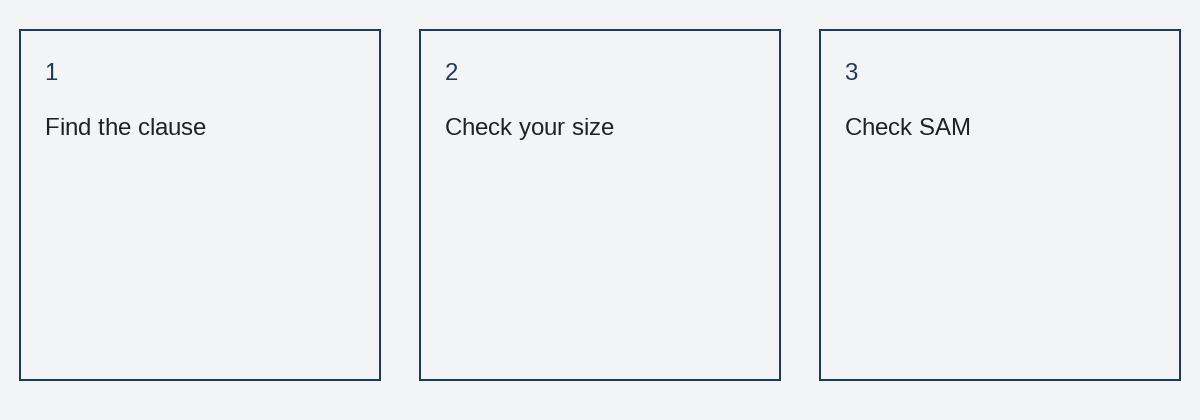
Reading a set-aside notice before you bid
- Find the clause. Read the set-aside type on the notice and find the matching clause in the solicitation (for a total set-aside, 52.219-6).
- Check your size. Note the NAICS code and the size standard written in the solicitation, then read the current line of 13 CFR 121.201.
- Check SAM. Confirm your SAM registration is active and will stay active through award, and note the expiration date.
- Review representations. Review your annual representations in SAM, including 52.219-1, and list any change for this solicitation in the 52.204-8 table.
- Plan the work split. Check your self-performance plan against the percentages of 52.219-14.
- Fill the cover page. Put your Unique Entity Identifier on the cover page as 52.204-7 asks.
Frequently asked questions
Can a firm that is not small join a set-aside bid as a subcontractor?
The prime offeror must be small under the solicitation's size standard. Subcontracting is allowed within the limits of 52.219-14 when that clause is in the solicitation, so read the percentage that applies to your type of work.
My SAM registration expired last month. Can I renew it after I submit?
FAR 4.1102 and 52.204-7 require registration at the time you submit the offer, and 52.204-7 also at award. Renew before you submit, and allow time for the renewal to become active.
Where do I find the size standard for my trade?
The solicitation names the NAICS code and its size standard. The full SBA table is in 13 CFR 121.201; read it on the day you prepare the offer because SBA revises it.
Does growing past the size standard during the job change my status on that contract?
Under 13 CFR 121.404(a), size is generally determined on the date you self-certify with your initial offer including price. The regulation has exceptions, so read it in full if your situation is unusual.
Sources and republications
The dates below concern links. They do not certify a full substantive review; claims and applicable versions still need review. Article review record.
- FAR 52.219-6, Notice of Total Small Business Set-Aside, link checked on
- FAR 19.502-2, Total small business set-asides, link checked on
- FAR 19.502-3, Partial small business set-asides, link checked on
- 13 CFR 121.201, What size standards has SBA identified by NAICS codes? (Cornell republication), link checked on
- 13 CFR 121.404, When is the size status of a business concern determined? (Cornell republication), link checked on
- FAR 4.1102, Policy (System for Award Management), link checked on
- FAR 52.204-7, System for Award Management, link checked on
- FAR 52.204-8, Annual Representations and Certifications, link checked on
- FAR 52.219-1, Small Business Program Representations, link checked on
- FAR 52.219-14, Limitations on Subcontracting, link checked on