The HUBZone program rewards small firms for locating and hiring in economically distressed areas. This page explains what counts as a principal office and as a resident employee under 13 CFR part 126, how the 35 percent rule is counted for a construction crew, and the three ways HUBZone status helps on a bid under FAR subpart 19.13.
Not legal advice: this article explains the general rules; the solicitation of each contract governs.
Key terms
- HUBZone
- A historically underutilized business zone: an area such as a qualified census tract or non-metropolitan county that SBA maps as economically distressed.
- Principal office
- Under 13 CFR 126.103, the location where the greatest number of the firm's employees perform their work, leaving out employees who spend most of their time at job sites.
- HUBZone resident employee
- An employee who lives full time in a HUBZone and has lived there at least 90 calendar days before the date SBA reviews.
- Price evaluation preference
- A 10 percent factor that FAR 19.1307 adds to competing offers in a full and open competition, so a certified HUBZone firm can win at a somewhat higher price.
What the HUBZone program does
SBA's program page describes HUBZone as a program that limits competition for certain contracts to businesses in historically underutilized business zones, and gives certified firms a 10 percent price evaluation preference in full and open competitions. It also states the governmentwide goal of awarding 3 percent of prime contract dollars to HUBZone small businesses.
The program ties a company's federal advantage to two facts that you control: where your main office is, and where your employees live. Both are checked against SBA's HUBZone map at maps.certify.sba.gov. The program page says the map was last updated in 2023, is due for an update during 2026, and will be updated again in July 2028 to reflect changes in qualified census tracts and qualified non-metropolitan counties.
A map update can move an address in or out of a HUBZone. Check your office and your employees' addresses again each time SBA announces one.
The requirements in 13 CFR 126.200
13 CFR 126.200 lists what a firm must show to be certified. It must be small under the SBA size standard for a NAICS code in its SAM profile, and to receive a HUBZone contract it must be small under the size standard of that contract's NAICS code. It must be at least 51 percent owned and controlled by U.S. citizens, or owned under one of the other forms the section lists, such as an Alaska Native Corporation, an Indian tribal government, a certified development company, a small agricultural cooperative or a Native Hawaiian Organization.
Its principal office must be in a HUBZone, and at least 35 percent of its employees must live in a HUBZone. Neither the firm nor its owners may have an active exclusion in SAM, and the firm is not certified if it or a principal has failed to pay significant federal financial obligations, unless they are current on an approved repayment plan or the debt was settled.
Paragraph (d)(1) rounds the 35 percent count to the nearest whole number. A firm with 20 employees needs 7 HUBZone residents; with 12 employees, 4.2 rounds to 4. A firm with a single employee needs that person to live in a HUBZone.
| Requirement | What the rule asks | Paragraph |
|---|---|---|
| Ownership | At least 51 percent owned and controlled by U.S. citizens, or one of the other listed ownership forms | 126.200(a) |
| Size | Small under the size standard for a NAICS code in the SAM profile, and for the contract's NAICS code at award | 126.200(b) |
| Principal office | Located in a HUBZone, except for concerns owned by Indian tribal governments | 126.200(c) |
| Employees | At least 35 percent are HUBZone residents, rounded to the nearest whole number | 126.200(d) |
| During a HUBZone contract | Attempt to maintain at least 35 percent HUBZone residents | 126.200(e) |
| Exclusions and federal debts | No active SAM exclusion; no unpaid significant federal financial obligations | 126.200(f) and (g) |
Principal office: the rule for construction crews
13 CFR 126.103 defines the principal office as the location where the greatest number of employees perform their work. The firm needs a deed or an active lease that started at least 30 calendar days before the date of review and runs at least 60 days after it, and it must actually operate from that location. SBA may ask for photos or a walkthrough.
For construction and service firms, the definition leaves out employees who spend more than half their time at job sites on specific contracts. Only the remaining staff are counted to find the principal office. The section gives an example of a construction firm with 78 employees, 75 of them at job sites: the 3 who work at the office located in a HUBZone make that office the principal office. If every employee works at job sites, the firm cannot meet the requirement.
Employees who split time between offices are assigned to the one where they spend more than half their time. If none gets more than half and one of the offices is outside a HUBZone, they count as working outside.
Who counts as an employee and as a resident
For the HUBZone program, 13 CFR 126.103 counts as an employee anyone who works at least 10 hours per week during the four weeks before the date of review, full time or part time. Workers from temporary agencies, leasing firms, unions or professional employer organizations count, and so do owners who work at least 10 hours a week. Unpaid non-owners, 1099 independent contractors who are not otherwise employees, and subcontractors do not.
To reside in a HUBZone, a person must live at the address full time and have lived there at least 90 calendar days before the date of review. SBA looks first at the address on a driver's license or other government ID, then at a deed, lease or utility bills if the ID does not match.
Paragraph (d)(3) of 126.200 lets a firm keep counting up to four legacy HUBZone employees: people who lived in a HUBZone for at least 180 days after the certification or anniversary date and stayed continuously employed, even if they later moved or their area lost its status. The firm must still have at least one other HUBZone resident employee, and legacy status does not apply to employees working fewer than 30 hours a week.
HUBZone set-asides and sole-source awards
FAR 19.1305 allows an acquisition above the micro-purchase threshold to be set aside for HUBZone small businesses when the contracting officer reasonably expects offers from two or more HUBZone firms and award at a fair market price. The contracting officer considers a HUBZone set-aside before a HUBZone sole-source award or a small business set-aside. If only one acceptable HUBZone offer arrives, the award should go to that firm; if none does, the set-aside is withdrawn and the requirement may go to a small business set-aside.
FAR 19.1306 allows a sole-source award to a HUBZone firm when the contracting officer does not expect two or more HUBZone offers, the anticipated price with options is no more than $8.5 million for manufacturing or $5.5 million for other NAICS codes, the requirement is not being performed by an 8(a) participant or accepted by SBA into the 8(a) program, the firm is responsible, and the price is fair and reasonable.
The 10 percent price evaluation preference
In a full and open competition, FAR 19.1307(b) has the contracting officer add a factor of 10 percent to all offers except those from HUBZone small businesses that have not waived the preference, and except otherwise successful offers from small businesses. The factor is applied line item by line item, or to any group of items on which award may be made, after other factors such as transportation costs have been added.
A fictitious example: a large business offers $1,000,000 and a certified HUBZone firm offers $1,080,000. For evaluation, the large business's offer becomes $1,100,000, so the HUBZone offer is lower. If the lowest offer had come from a small business that is not HUBZone certified, it would not be increased, and the preference would not help.
Paragraph (a) excludes cases where price is not a selection factor, such as architect-engineer acquisitions, where all fair and reasonable offers are accepted, such as multiple award schedule contracts, and the reserved part of a multiple-award solicitation. Under paragraph (d), if a HUBZone firm and a large business are tied after the preference, the award goes to the HUBZone firm.
Getting and keeping HUBZone certification
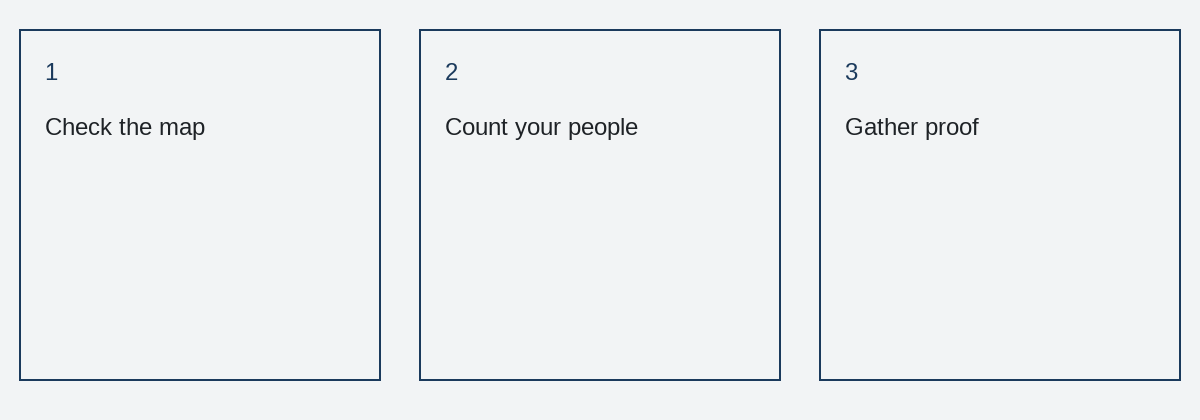
- Check the map. Enter your office address and each employee's home address on SBA's HUBZone map.
- Count your people. List employees working at least 10 hours a week, set aside job-site staff for the office test, and count residents.
- Gather proof. Collect the office deed or lease, payroll records and each resident employee's ID or proof of address.
- Apply online. Create an SBA account and apply through SBA Certifications at certifications.sba.gov.
- Recertify. Recertify every three years, as SBA's program page states, and recheck addresses after each map update.
Frequently asked questions
Do employees at a job site count toward the 35 percent rule?
The job-site exclusion in 13 CFR 126.103 applies to finding the principal office. The 35 percent residency test in 126.200(d) is counted on the firm's employees, so check the section and SBA's guidance for your own staffing before you rely on one reading.
How often must a HUBZone firm recertify?
SBA's program page says you need to recertify every three years. At recertification, 126.200(e)(2) lets a firm performing a HUBZone contract stay in with at least 20 percent resident employees if it is making documented efforts to reach 35 percent.
Does the 10 percent preference apply on a small business set-aside?
FAR 19.1307(a) ties the preference to acquisitions using full and open competition. A small business set-aside is a competition limited to small firms, so the solicitation will normally not apply the 10 percent factor; read its evaluation section to be sure.
Can my home be my principal office?
Be careful. 13 CFR 126.200(c)(1)(iii) excludes a personal residence from the 10-year long-term investment rule, and 126.103 requires a deed or lease and proof that the firm actually operates from the location. SBA may ask for photos or a walkthrough.
Sources and republications
The dates below concern links. They do not certify a full substantive review; claims and applicable versions still need review. Article review record.
- 13 CFR 126.103, What definitions are important in the HUBZone Program? (Cornell republication), link checked on
- 13 CFR 126.200, What requirements must a concern meet to be certified as a HUBZone small business concern? (Cornell republication), link checked on
- FAR 19.1305, HUBZone set-aside procedures, link checked on
- FAR 19.1306, HUBZone sole source awards, link checked on
- FAR 19.1307, Price evaluation preference for HUBZone small business concerns, link checked on
- SBA, HUBZone program, link checked on