If you are a service-disabled veteran who owns a small business, part of the federal market is reserved for firms like yours. This page explains the ownership rules, how SBA certification works and how long it lasts, when a contracting officer sets a job aside or awards it sole source, and what the clause in the solicitation asks of you after award.
Not legal advice: this article explains the general rules; the solicitation of each contract governs.
Key terms
- SDVOSB
- A service-disabled veteran-owned small business: a small concern not less than 51 percent owned and controlled by one or more service-disabled veterans who also control its management and daily operations.
- VetCert
- The Veteran Small Business Certification Program run by SBA, which took over veteran certification from the Department of Veterans Affairs on January 1, 2023. Certified firms appear in SBA's certification database and in SAM.
- Service-disabled veteran
- Under 13 CFR 128.102, a veteran registered as service-disabled in the Beneficiary Identification and Records Locator Subsystem kept by the VA's Veterans Benefits Administration, or a successor system.
- Rule of two
- The trade name for the market research test in FAR 19.1405(b): two or more certified SDVOSB concerns are expected to offer, and award can be made at a fair market price.
Who counts as an SDVOSB
The ownership rules sit in 13 CFR part 128, the Veteran Small Business Certification Program. Under 13 CFR 128.200(b), a service-disabled veteran-owned small business must meet two tests. It must be small under the size standard of a NAICS code listed in its SAM profile. And it must be not less than 51 percent owned and controlled by one or more service-disabled veterans who reside in the United States.
Who counts as a service-disabled veteran is defined in 13 CFR 128.102: a veteran registered as service-disabled in the Beneficiary Identification and Records Locator Subsystem of the VA's Veterans Benefits Administration. In practice, the VA disability rating is the starting point. SBA does not rate disabilities itself.
There is one exception on ownership. For a veteran whose disability the VA has rated permanent and total, and who cannot manage the daily business operations, 13 CFR 128.200(b) allows ownership by a spouse or a permanent caregiver who resides in the United States. Section 128.102 requires a written VA determination of the permanent and total disability when a caregiver is appointed.
Ownership alone is not enough. The FAR clause at 52.219-27 adds that the management and daily business operations must be controlled by one or more service-disabled veterans. A firm where the veteran holds the shares but someone else runs the jobs, signs the contracts and hires the crews is exposed to a status protest.
SBA certification: VetCert
Self-certification is over for set-asides. SBA's veteran contracting page states that SBA took over veteran small business certification from the VA on January 1, 2023. Under 13 CFR 128.200(c), a concern must be certified to receive an SDVOSB set-aside or sole-source contract. The deadline for firms relying on self-certification was December 31, 2023 for set-aside and sole-source contracts outside the VA.
Under 13 CFR 128.300, the concern applies to SBA with evidence that it is a small business owned and controlled by qualifying veterans. SBA reviews the file and, if the firm meets the requirements, lists it as certified in the certification database. Section 128.301 says applications are filed electronically following the instructions on sba.gov, and the qualifying veteran answers for the accuracy of everything submitted. SBA's page points applicants to its certification portal, certifications.sba.gov.
Certification is not permanent. Under 13 CFR 128.306, a participant recertifies every 3 years, and may file up to 90 calendar days before its certification period ends. A firm that misses the date is decertified, but SBA reinstates it if it recertifies within 30 days after the period ends. In between, the firm must report changes that could affect its status within 30 calendar days.
| Event | Time limit | Rule |
|---|---|---|
| Recertification | Every 3 years | 13 CFR 128.306(a) |
| Earliest recertification filing | 90 calendar days before the period ends | 13 CFR 128.306(a) |
| Reinstatement after a missed recertification | Within 30 days after the period ends | 13 CFR 128.306(a) |
| Report of a change affecting status | Within 30 calendar days | 13 CFR 128.306(b), 128.307 |
| Self-certification cutoff for set-asides and sole source outside the VA | December 31, 2023 | 13 CFR 128.200(c) |
SDVOSB set-asides: the rule of two
FAR subpart 19.14 governs the program in federal contracts. Under FAR 19.1405(a), a contracting officer may set aside acquisitions above the micro-purchase threshold for competition restricted to SDVOSB concerns, and must consider an SDVOSB set-aside before an SDVOSB sole-source award or a small business set-aside.
The test is in 19.1405(b). Market research must reasonably support two findings: two or more certified SDVOSB concerns will submit offers, and award will be made at a fair market price. If you want an agency to set work aside, answer its sources-sought notices. Your reply is part of the market research that supports the set-aside.
Under 19.1405(c), the contracting officer checks each offeror. A firm designated in SAM as an SBA-certified SDVOSB passes this check. So does a firm that represented SDVOSB status in SAM and applied to SBA on or before December 31, 2023, while its application is pending in the VetCert database. Offers from any other firm are removed from consideration.
If only one acceptable offer comes from a certified SDVOSB, 19.1405(d) says the contracting officer should award to it. If none comes in, the set-aside is withdrawn, and the requirement, if still valid, may be set aside for small business in general.
Sole-source awards and their dollar limits
When only one SDVOSB is expected, FAR 19.1406 allows a sole-source award. The contracting officer considers it before a small business set-aside when all of the conditions in paragraph (a) hold: no reasonable expectation of offers from two or more SDVOSBs, an anticipated price within the dollar limit including options, work not already performed by an 8(a) participant or accepted into the 8(a) program, a responsible SDVOSB, and a fair and reasonable price.
The dollar limits on 28 October 2026 read $8.5 million for a requirement within the NAICS codes for manufacturing and $5 million for any other NAICS code. These figures include options. The same certification rule as for set-asides applies under 19.1406(b), and SBA may appeal a decision not to make a sole-source award.
| Point | SDVOSB set-aside | SDVOSB sole source |
|---|---|---|
| Expected offers | Two or more certified SDVOSBs | No reasonable expectation of two or more |
| Dollar range | Above the micro-purchase threshold | Up to $5 million, or $8.5 million in manufacturing NAICS codes, options included |
| Price test | Fair market price | Fair and reasonable price |
| Order of consideration | Before sole source and before small business set-asides | Before small business set-asides |
| Who may receive award | SBA-certified SDVOSB, or pending applicant from the 2023 transition | Same, and determined responsible |
The 52.219-27 clause and the work you must keep
A set-aside or sole-source solicitation carries FAR 52.219-27. The version in the FAR on 28 October 2026 is dated February 2024. Paragraph (c)(1) says offers from concerns outside the program, as it defines them, shall not be considered. Paragraph (e) covers joint ventures: the SDVOSB party or parties must perform at least 40 percent of the work performed by the joint venture, and that work must be more than administrative functions.
Under 13 CFR 128.401, the firm must also comply with the limitations on subcontracting in 13 CFR 125.6. When your solicitation includes FAR 52.219-14, the clause dated October 2022 caps what you may pay to subcontractors that are not similarly situated entities, measured against what the Government pays you. Read the clauses list of your own solicitation to see which apply.
Section 128.401 also brings in the ostensible subcontractor rule. A prime loses the award if a subcontractor that is not certified performs the primary and vital requirements of the contract, or if the prime is unduly reliant on it. For general construction, the section names management, supervision and oversight of the project as primary and vital. If a larger partner runs your site, you are at risk.
Size matters at a precise moment: for a competitive award, the firm must be small under the NAICS size standard at its initial offer; for a sole-source award, on the date of award.
| Type of contract | Maximum paid to such subcontractors | Cost of materials |
|---|---|---|
| Services, except construction | 50 percent of the amount paid by the Government | Not applicable |
| Supplies, other than from a nonmanufacturer | 50 percent | Excluded |
| General construction | 85 percent | Excluded |
| Special trade construction | 75 percent | Excluded |
What to check before you bid an SDVOSB notice
The federal government aims to award at least 5 percent of all federal contracting dollars to SDVOSBs each year, according to SBA. That goal is why agencies look for certified firms. It does not entitle any firm to a contract: each award follows the rules above and the terms of the solicitation.
Before you price a notice marked SDVOSB, check four things. Your certification is active in SAM and in the SBA database, not just pending recertification. You are small under the NAICS code of this solicitation. Your plan for the work keeps you within the subcontracting limits. And your own people will manage and supervise the job.
Contracts for the Department of Veterans Affairs have their own program, Vets First, which SBA's page mentions alongside government-wide set-asides. If you bid VA work, read the VA clauses in that solicitation as well.
- Certification status and its end date.
- Size under the NAICS code of the solicitation.
- Share of the work you will perform yourself, by type of contract.
- Who will manage and supervise the site.
- Joint venture terms, if you team: at least 40 percent of the work for the SDVOSB party.
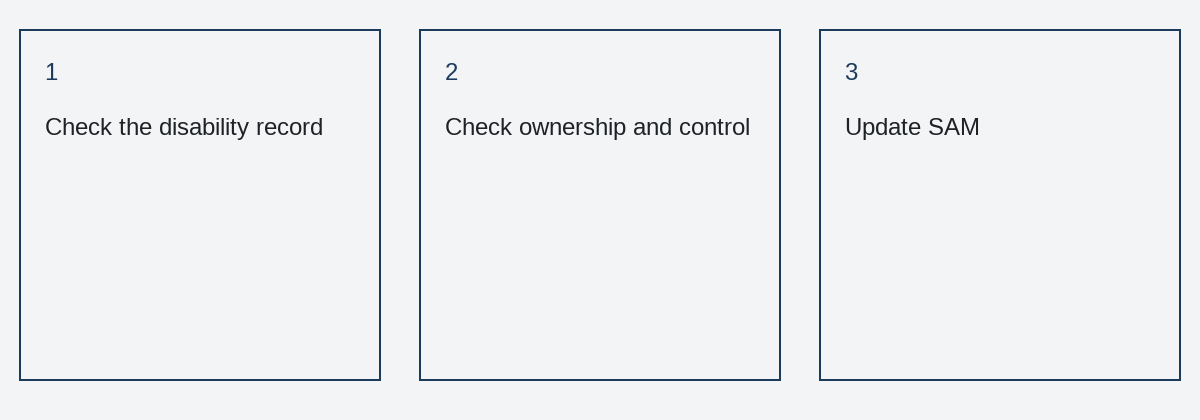
Getting and keeping SDVOSB certification
- Check the disability record. Confirm that the VA records the owning veteran as service-disabled, since SBA relies on that registration.
- Check ownership and control. Make sure service-disabled veterans own at least 51 percent and run daily operations and management.
- Update SAM. Keep your SAM registration active with the NAICS codes you work in, since size is measured against them.
- Apply to SBA. File the application electronically through SBA's certification portal, with evidence of ownership, control and size.
- Report changes. Tell SBA within 30 calendar days about any change that could affect your status.
- Recertify. Recertify every 3 years, starting up to 90 days before your certification period ends.
Frequently asked questions
Can I still self-certify as an SDVOSB on SAM?
Not for set-asides or sole-source awards. Since January 1, 2024, FAR 19.1405(c) and 19.1406(b) require SBA certification, except for firms that applied on or before December 31, 2023 and are still pending.
What is the SDVOSB sole-source limit?
FAR 19.1406 sets $8.5 million for manufacturing NAICS codes and $5 million for any other NAICS code, options included. The other conditions of the section must also be met.
How long does VetCert certification last?
Three years. Under 13 CFR 128.306 you may recertify up to 90 days before the end, and a firm that misses the date is reinstated if it recertifies within 30 days.
Can my spouse own the business if I cannot run it?
Only in one case: when the VA has rated your disability permanent and total and you cannot manage daily operations. Then 13 CFR 128.200(b) allows ownership by a spouse or permanent caregiver residing in the United States.
Does SDVOSB certification also make me a VOSB?
Part 128 covers both statuses. An SDVOSB meets the veteran ownership test with service-disabled veterans, so it is also owned by veterans; check how your SBA certification lists your firm before bidding a VOSB notice.
Sources and republications
The dates below concern links. They do not certify a full substantive review; claims and applicable versions still need review. Article review record.
- 13 CFR 128.102, Definitions (Veteran Small Business Certification Program) (Cornell republication), link checked on
- 13 CFR 128.200, What are the requirements a concern must meet to qualify as a VOSB or SDVOSB? (Cornell republication), link checked on
- 13 CFR 128.300, How does a concern become certified as a VOSB or SDVOSB? (Cornell republication), link checked on
- 13 CFR 128.301, Where must an application for certification be filed? (Cornell republication), link checked on
- 13 CFR 128.306, Recertification and continuing requirements (Cornell republication), link checked on
- 13 CFR 128.401, Contracting requirements for VOSB and SDVOSB awards (Cornell republication), link checked on
- FAR 19.1405, Service-disabled veteran-owned small business set-aside procedures, link checked on
- FAR 19.1406, Sole source awards to service-disabled veteran-owned small business concerns, link checked on
- FAR 52.219-27, Notice of Set-Aside for, or Sole-Source Award to, SDVOSB Concerns, link checked on
- FAR 52.219-14, Limitations on Subcontracting, link checked on
- U.S. Small Business Administration, Veteran contracting assistance programs, link checked on