If women own and run your small business, a share of federal work can be reserved for firms like yours, but only in certain industries. This page explains the two tiers, WOSB and EDWOSB, the dollar limits of the economic test, how SBA certification works, and when a contracting officer may set a job aside or award it sole source.
Not legal advice: this article explains the general rules; the solicitation of each contract governs.
Key terms
- WOSB
- A women-owned small business: a small concern not less than 51 percent unconditionally and directly owned and controlled by one or more women who are citizens of and reside in the United States.
- EDWOSB
- An economically disadvantaged women-owned small business: a WOSB whose owning women also stay under SBA's limits on personal net worth, adjusted gross income and total assets.
- Underrepresented NAICS code
- An industry code where SBA has found women-owned firms underrepresented (EDWOSB set-asides) or substantially underrepresented (WOSB set-asides) in federal procurement. SBA publishes the list on its program page.
Two tiers: WOSB and EDWOSB
The program has two levels, both defined in 13 CFR 127.200. A WOSB is a small business not less than 51 percent unconditionally and directly owned and controlled by one or more women who are citizens of and reside in the United States. An EDWOSB meets the same test, but the owning women must also be economically disadvantaged.
In both cases, the firm must be small under the size standard of at least one NAICS code in its SAM profile. Size is measured against the code of the solicitation you bid, so a firm can be small for one job and large for another.
The words 'unconditionally and directly' matter. If your shares sit in a holding company or come with conditions attached, have the structure reviewed against 13 CFR part 127 before you apply. SBA's page adds that women must manage the business day to day and make its long-term decisions. A firm where the woman owner holds the shares but a relative runs the jobs is exposed to a challenge.
The economic test for EDWOSB
13 CFR 127.203 sets three dollar limits for each woman whose ownership counts toward the 51 percent. Her personal net worth must be less than $850,000, not counting her ownership interest in the concern, her equity in her primary residence, and funds in an IRA or other official retirement account. Her adjusted gross income, averaged over the three years before certification, is presumed too high above $400,000, a presumption she can rebut. And she generally is not considered economically disadvantaged if the fair market value of all her assets, including her home and the business, exceeds $6.5 million.
The asset test counts what the net worth test leaves out. A business owner with a modest net worth can still exceed $6.5 million in total assets if the business and the house are worth a lot. Only funds in qualified retirement accounts are excluded from that total.
If you are close to a limit, gather the figures before you apply: your last three tax returns, a personal financial statement and a valuation of the business. These limits are the ones the regulation shows on 28 October 2026.
| Test | Limit | What is left out |
|---|---|---|
| Personal net worth | Less than $850,000 | Her ownership interest in the concern, her equity in her primary residence, and funds in an IRA or other official retirement account |
| Adjusted gross income | $400,000 averaged over the three years before certification (rebuttable presumption) | Nothing stated in the limit itself |
| Total assets at fair market value | Not more than $6.5 million | Only funds in qualified retirement accounts |
Certification: free from SBA
Self-representation in SAM is not enough for a set-aside or sole-source award: the firm must be certified. Under 13 CFR 127.300, a concern applies to SBA, and the regulation states that there is no cost to apply. SBA may decide from the file alone, ask for more information or verify it, and it may deny certification if the firm does not cooperate. A certified firm receives a letter and is listed in SAM or SBA's Dynamic Small Business Search.
There are other routes. A WOSB may rely on a certification from an approved third-party certifier, or show it is a women-owned and controlled firm already certified in SBA's veteran program. An 8(a) participant owned and controlled by women counts as an EDWOSB. The regulation does not state third-party certifier fees, so ask before you choose that route.
Keeping the status takes work. SBA's page says participants must attest every year, within 30 days of the certification anniversary, but that the annual attestation is currently in abeyance. A program examination takes place every three years, and the SAM.gov profile must be updated each year to keep the firm visible in SBA's search tool.
Set-asides: only in designated NAICS codes
The program does not apply to every contract. Under FAR 19.1505(a), a contracting officer may set aside an acquisition above the micro-purchase threshold for EDWOSB concerns when its NAICS code is one where SBA has found women-owned firms underrepresented. A set-aside open to all WOSBs, EDWOSBs included, requires a code where SBA found them substantially underrepresented. SBA publishes the list of qualifying NAICS codes on its program page.
On top of the code, the rule of two applies. Under 19.1505(b) and (c), market research must give a reasonable expectation that two or more firms of the right tier will offer and that award can be made at a fair and reasonable price.
Before award, 19.1505(f) requires the contracting officer to confirm the apparent winner's certification in SAM or a pending application. When the application is pending, the contracting officer asks SBA, which has 15 calendar days to answer. Without an answer, the contracting officer may wait longer or move on to the next offeror. Award never goes to a firm that is not certified.
If a single acceptable offer arrives from a certified firm, 19.1505(g) allows award to it. If none arrives, the set-aside is withdrawn and the work is considered for a small business set-aside under FAR subpart 19.5.
| Point | EDWOSB set-aside | WOSB set-aside |
|---|---|---|
| NAICS code | Code where SBA found women-owned firms underrepresented | Code where SBA found them substantially underrepresented |
| Who may offer | Certified EDWOSBs | Certified WOSBs, EDWOSBs included |
| Expected offers | Two or more EDWOSBs | Two or more WOSBs |
| Price test | Fair and reasonable price | Fair and reasonable price |
| Pending certification at award | Contracting officer asks SBA, which has 15 calendar days | Same |
Sole-source awards
When only one firm of the right tier is expected, FAR 19.1506 lets the contracting officer consider a sole-source award before a small business set-aside. The same NAICS code conditions apply, the firm must be responsible, the price must be fair and reasonable, and the award goes only to a concern certified under 13 CFR 127.300.
The dollar limits on 28 October 2026 read $8.5 million for a requirement within the NAICS codes for manufacturing and $5.5 million for any other NAICS code, options included. They differ from the limits of the veteran program, so do not carry a figure from one program to the other.
After award: the work you keep
A set-aside award comes with limits on how much of the work you pass on. When your solicitation includes FAR 52.219-14, dated October 2022, paragraph (e) caps what you may pay to subcontractors that are not similarly situated entities: 50 percent of the amount paid by the Government for services, 85 percent for general construction and 75 percent for special trade construction, the last two excluding the cost of materials.
SBA states a government-wide goal of 5 percent of federal prime contracting dollars for women-owned small businesses. The goal explains why contracting officers look for certified firms. It does not reserve any given job for you, and each solicitation sets its own terms.
- Check that the NAICS code of the notice is on SBA's list for your tier.
- Check that your certification is active in SAM.
- Check your size under that NAICS code.
- Plan the share of work your own crews will perform.
Getting WOSB or EDWOSB certification
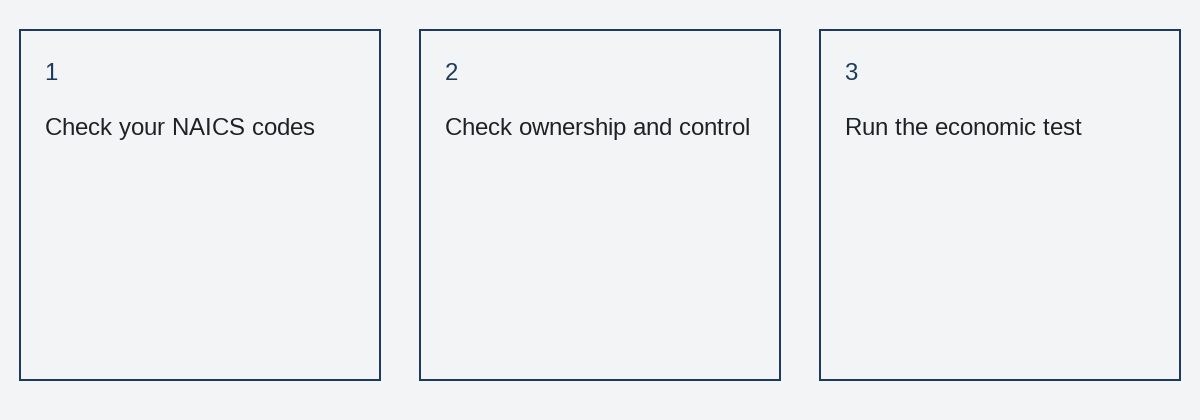
- Check your NAICS codes. Look up your trade's codes on SBA's list to see whether set-asides are possible for WOSBs, EDWOSBs or neither.
- Check ownership and control. Confirm that women who are U.S. citizens own at least 51 percent directly and run the business.
- Run the economic test. If you aim for EDWOSB, compare each owner's net worth, average income and total assets with the three limits.
- Update SAM. Make sure your SAM registration is active and lists the NAICS codes you work in.
- Apply. Apply to SBA at no cost, or through an approved third-party certifier, with your ownership and financial documents.
- Keep it current. Update SAM each year and prepare for the program examination every three years.
Frequently asked questions
Does the WOSB program apply to construction?
Only where the NAICS code of the contract is on SBA's list for the program. FAR 19.1505 allows set-asides only in codes where SBA found women-owned firms underrepresented or substantially underrepresented, so check your codes on SBA's page.
How much does WOSB certification cost?
Applying to SBA is free under 13 CFR 127.300. Third-party certifiers are another route; the regulation does not state their fees.
What are the EDWOSB limits?
Under 13 CFR 127.203, each owning woman's personal net worth must be under $850,000, her income averaged over three years is presumed too high above $400,000, and total assets above $6.5 million generally rule her out.
What is the WOSB sole-source limit?
FAR 19.1506 sets $8.5 million for manufacturing NAICS codes and $5.5 million for other codes, options included. All other conditions of the section must also hold.
Do I need to file an annual attestation?
SBA's program page says the annual attestation is currently in abeyance. A program examination every three years and a yearly SAM update still apply.
Sources and republications
The dates below concern links. They do not certify a full substantive review; claims and applicable versions still need review. Article review record.
- 13 CFR 127.200, What are the requirements a concern must meet to qualify as an EDWOSB or WOSB? (Cornell republication), link checked on
- 13 CFR 127.203, What are the rules governing the requirement that economically disadvantaged women must own EDWOSBs? (Cornell republication), link checked on
- 13 CFR 127.300, How is a concern certified as an EDWOSB or WOSB? (Cornell republication), link checked on
- FAR 19.1505, Set-aside procedures (Women-Owned Small Business Program), link checked on
- FAR 19.1506, Women-Owned Small Business Program sole source awards, link checked on
- FAR 52.219-14, Limitations on Subcontracting, link checked on
- U.S. Small Business Administration, Women-Owned Small Business Federal Contract Program, link checked on