The 8(a) program reserves part of federal spending for small firms run by disadvantaged owners, and it changed in 2026. This page sets out who can join under 13 CFR part 124, how long a firm stays in, how contracts reach 8(a) firms under FAR subpart 19.8, and the dollar limits on sole-source awards.
Not legal advice: this article explains the general rules; the solicitation of each contract governs.
Key terms
- 8(a) participant
- A firm SBA has admitted to the 8(a) Business Development program. When it performs a contract reserved for the program, FAR 19.800 calls it an 8(a) contractor.
- Sole-source award
- A contract given to one firm without a competition. In the 8(a) program it is allowed below set dollar thresholds, or above them in the cases FAR 19.805-1(b) lists.
- Adjusted net worth
- An owner's net worth after excluding the equity in a primary residence, the ownership interest in the applicant firm and funds in official retirement accounts (13 CFR 124.104).
How the program works
Section 8(a) of the Small Business Act lets the Small Business Administration contract with other federal agencies for any type of work and then subcontract that work to small firms admitted to the program. FAR 19.800 describes this arrangement and names it the 8(a) Business Development program.
In practice, an agency offers a requirement to SBA, SBA accepts it into the program, and the contract is awarded either sole source to one participant or through a competition limited to participants. SBA certifies to the agency that the participant is capable and responsible for the specific contract, and the contracting officer decides whether to award on terms both sides agree to.
FAR 19.800 also tells contracting officers that, for acquisitions above the simplified acquisition threshold, they must consider 8(a) set-asides or sole-source awards before small business set-asides. That ordering is why some requirements a small firm expected to see as an open small business set-aside never appear on SAM.gov as one.
Who can join
13 CFR 124.101 sets the basic test. A concern generally meets the basic requirements if it is a small business, unconditionally owned and controlled by one or more socially and economically disadvantaged individuals who are of good character and citizens of and residing in the United States, and if it demonstrates potential for success.
SBA's program page adds practical conditions. The firm must be small under SBA size standards and at least 51 percent owned and controlled by disadvantaged U.S. citizens, and it must not have taken part in the program before. The page describes the program as aimed at owners who have been in business for at least two years. Firms owned by Alaska Native Corporations, Community Development Corporations, Indian tribes and Native Hawaiian Organizations can also take part under their own rules.
Size is measured against the NAICS code of your main line of work. A general building contractor and a specialty trade contractor face different size standards, so check yours before you prepare an application.
The economic limits on owners
13 CFR 124.104 sets three dollar tests for each individual who claims disadvantage. Each one is applied to the person, not to the company.
Exclusions matter as much as the numbers. Equity in the primary residence and the ownership interest in the applicant firm are left out of net worth, but both count toward total assets. Funds in an IRA or other official retirement account are not counted in net worth. An owner who keeps a lot of money in the business and draws a modest salary can pass the net worth test and still be close to the asset limit, so add up both before applying.
| Test | Limit | What is left out |
|---|---|---|
| Net worth | Less than $850,000 | Equity in the primary residence, the interest in the applicant firm, official retirement accounts |
| Personal income | Adjusted gross income averaged over the three preceding years above $400,000 creates a presumption of not being disadvantaged | Set by the section's income rules |
| Total assets | Fair market value of all assets above $6.5 million generally disqualifies | Only qualified IRA funds; the residence and the firm are counted |
Social disadvantage after the 2026 rule
The test for social disadvantage changed in 2026. The current text of 13 CFR 124.103, which carries the citation 91 FR 51572 of August 11, 2026, contains no list of groups presumed to be socially disadvantaged. It refers to prior versions of the section that gave some groups a rebuttable presumption.
Under the current text, a citizen shows social disadvantage by establishing that, during the citizen's lifetime, a U.S. government or private entity, such as a university or a corporation, discriminated against or was biased toward a definable racial, ethnic or cultural group the citizen belongs to, or favored a group the citizen does not belong to, and that this caused the citizen material harm. Material harm means lost access to, or reduced opportunities for, economic advancement.
The section asks for two things. First, evidence of the entity's action, policy, rule or practice, such as official policies, reports, statements of officials, audits or court decisions, or other adequate evidence when entity-specific proof is not readily available. Second, a self-certification that the citizen belonged to the affected group while the practice was in effect and suffered material harm from it. If you applied or were admitted under the earlier rules, read the current section and SBA's notices before your next review.
The nine-year term
13 CFR 124.2 sets a program term of nine years, counted from the date of SBA's approval letter certifying the firm's admission. SBA's program page describes the first four years as a developmental stage and the last five as a transitional stage, and says an individual may use the program only once in a lifetime.
Nine years passes faster than it seems for a construction firm, where the first contracts often go to building past performance. Plan early which agencies and which kinds of work you want to target, because the window does not reopen.
Sole source or competition: the thresholds
FAR 19.805-1(a) limits an acquisition to competition among 8(a) participants when its anticipated total value, options included, exceeds $8.5 million for manufacturing NAICS codes or $5.5 million for all other acquisitions, provided there is a reasonable expectation that at least two responsible participants will submit offers and that award can be made at a fair market price. Construction falls in the second group.
Below those amounts, an 8(a) requirement can be awarded sole source. Above them, FAR 19.805-1(b) still allows SBA to accept a sole-source award when two responsible participants are not expected to offer at a fair market price, or when SBA accepts the requirement on behalf of a firm owned by an Indian tribe or an Alaska Native Corporation.
When an agency offers a requirement, FAR 19.804-2 lists what its offering letter to SBA contains, including the work, the NAICS code, the anticipated value with options, bonding requirements and the acquisition history. The letter may also name a nominated 8(a) participant, with a justification. An agency that already knows your firm and your work can therefore ask SBA for you by name.
| Kind of acquisition | Sole source possible up to | Above that amount |
|---|---|---|
| Manufacturing NAICS codes | $8.5 million, options included | Competition among 8(a) participants, unless an exception in 19.805-1(b) applies |
| All other acquisitions, including construction and services | $5.5 million, options included | Competition among 8(a) participants, unless an exception in 19.805-1(b) applies |
| Requirement accepted for a firm owned by an Indian tribe or Alaska Native Corporation | Sole source accepted above the threshold | No competition required under 19.805-1(b) |
Applying to the 8(a) program
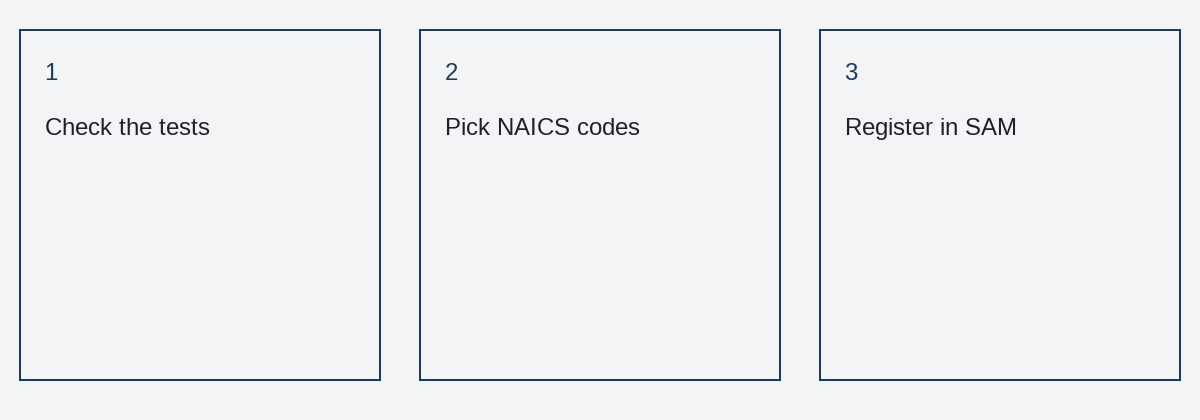
- Check the tests. Compare each disadvantaged owner's net worth, income and assets with the limits in 13 CFR 124.104.
- Pick NAICS codes. Identify the primary NAICS code of your firm and confirm it is small under that size standard.
- Register in SAM. Register or update your entity registration on SAM.gov before you apply.
- Apply online. Create an SBA account and submit the application through SBA Certifications at certifications.sba.gov.
- Wait for the decision. SBA's page says it has 90 days to decide once the application is complete.
Frequently asked questions
Can I bid on an 8(a) solicitation if my firm is not in the program?
No. A competitive 8(a) acquisition is limited to 8(a) participants under FAR 19.805-1. You can still work on the job as a subcontractor to the participant that wins.
Can a firm leave and re-enter the 8(a) program later?
SBA's page says an individual may participate only once in a lifetime and that a firm must not have participated before. The nine-year term in 13 CFR 124.2 does not restart.
Does my house count toward the $850,000 net worth limit?
No. 13 CFR 124.104 excludes equity in the primary residence from net worth, except any part that comes from excessive withdrawals from the firm. The house does count toward the $6.5 million total asset limit.
What is the 8(a) sole-source limit for construction?
Construction is not a manufacturing NAICS code, so the $5.5 million figure in FAR 19.805-1(a)(2) applies, options included. Above it, the requirement is normally competed among 8(a) participants.
Sources and republications
The dates below concern links. They do not certify a full substantive review; claims and applicable versions still need review. Article review record.
- FAR 19.800, General (8(a) program), link checked on
- FAR 19.804-2, Agency offering, link checked on
- FAR 19.805-1, General (competitive 8(a)), link checked on
- 13 CFR 124.2, What length of time may a business participate in the 8(a) BD program? (Cornell republication), link checked on
- 13 CFR 124.101, What are the basic requirements a concern must meet for the 8(a) BD program? (Cornell republication), link checked on
- 13 CFR 124.103, Who is socially disadvantaged? (Cornell republication), link checked on
- 13 CFR 124.104, Who is economically disadvantaged? (Cornell republication), link checked on
- SBA, 8(a) Business Development program, link checked on